Monday, June 18, 2018

Wall Paper Activity


Wall Paper Activity

Procedure of Portion Demonstrated
  1. T explains the rules of this activity showing the ppt to Ss.
     
  2. Each student run to the wall paper on the classroom walls and fill in the blanks using his/her left hand( if a student is left handed, he/she should use a right hand.)
     
  3. If Ss are finished with their work on the paper, they should go to the teacher and have their answers checked by the teacher.
     
  4. If all their answers are all correct, they can take the worksheet to their desks and work on the clues on the back of the paper and work in groups to figure out a secret sentence.
     
  5. The first group who guesses the secret sentence first is the winner.

Reading memory game


Procedure of Portion Demonstrated

  • After learning the reading text of text book, Teacher can use this activity. 
  • The purpose of the activity is to make students read aloud the sentences in English and make them put scrambled sentences in order. By doing this, students can understand how all the sentences are connected in a paragraph. 
  • Teacher makes some groups of students and let them choose their number in their group. 
  • A student comes up to the front and teacher shows one sentence on the screen. 
  • A students memorize the sentence and write it down on their group worksheet after going back to their seats. 
  • All students takes turns to memorize scrambled sentences. 
  • After writing all sentences on the paper, students in groups discuss how all the scrambled sentences are connected together in one paragraph. 
  • Teacher can just tell Korean translated meaning to some students who have low ability and they can make the sentence in English with other team mates using Korean meaning.


Friday, June 15, 2018

Three-step Interview


Procedure
  1. Students will answer 9 questions about what they did in summer vacation.
  2. Students will ask 3 things from the questions to their partner.
  3. Students will deliver their partner’s story to the person across from them.
  4. Students will present what they listen to the whole class.


Three-step interview worksheet

Reading a book cover

MICROTEACHING OVERVIEW
Name:  Nam, Kyunghwa( Kate)                                                Grade Level: Grade 10
Topic/Lesson Title:
Reading a book cover

Source of Experimentation
 The Help written  by Kathryn Stockett

Language Skills:
Reading skills, speaking skills, and listening skills
Learning Objective:  (What will learners know or be able to do after this activity/lesson?)
  • Students can guess the meaning of the new word from the context. 
  • Students can find the information of characters, setting, and the theme of the book by reading the back cover of The Help. 
  • Students can check their understanding about the book by making questions about the text and answering others’ questions by doing Bingo game.

Materials/Tools/Links
  • Copies of the back over of The Help
  • Handouts
  • Whiteboards with markers
Overview of Entire Lesson
Students make a guess about the story from the book cover and read the back cover in groups. They check unknown words and find the information about the characters, setting, and theme. Students fill a bingo grid with the words from the text and play the game in their group.

Procedure of Portion Demonstrated

  • Pre-reading stage :
    Student make a guess about the story of The Help from the front cover.

  • While-reading stage: 

  1. Students in groups read the back cover of The Help and check the unknown words in the text. 
  2. Students in groups find the information from the text : characters, setting, and themes

  • Post-reading stage:
    Students in groups play the Bingo game by making comprehension questions about the text and answering them.

    HWP file: synopsis of the help

Reading & Making activity using ‘I can~’ expression


MICROTEACHING OVERVIEW
Name:   Euna Lee                                                      Grade Level:  Grade 3~4

Topic/Lesson Title: Reading & Making activity using ‘I can~’ expression.
Source of Experimentation
‘Missing number station’ activity of Math lesson and storytelling in Oversea lessons
Language Skills:
Speaking, listening, reading, writing
Learning Objective:  (What will learners know or be able to do after this activity/lesson?)
1) Students will be able to read and speak the sentences with ‘I can ~ .’
2) Students will be able to extend their vocabulary after the activities.
Materials/Tools/Links
1) ‘My Five Senses’ story (https://www.mystorybook.com/books/120349)
2)  Making a Poem (https://www.pinterest.co.kr/)
3)  Word cards, sticky notes
Overview of Entire Lesson
  1. Review of the body part words: ‘One little finger’ song
  2. Read the story: ‘My five Senses’
    Listen to the Teacher’s storytelling first, then read the story with the students again and make sure of the key words     
  3. Missing word station
  1. With a partner, visit each station.
  2. Find the missing word and write down it on the pair work card.(no.1~5)
  3. On No.6, find the missing words as many as you can.
  4. Design your own missing word question to share the class.
     4. Making ‘I can Poem’
          Each students make their own poem using the sentences and words of ‘Missing
         word station’ . after the making, share their works.
Procedure of Portion Demonstrated
  1. Review of the body part words: ‘One little finger’ song
     2. Read the story: ‘My five Senses’  
     3. Missing word station
     4. Making ‘I can Poem’

Wednesday, June 13, 2018


💎Sharing Ideas using the 'Diamond Map'💎

        • Writing sentences using the Diamond map

-  Have students complete in the 3 blanks on a Diamond map by sharing their ideas.

1. In the first blank : Each student writes down a sentence and rotate the paper 90°
2. In the second blank : Students write the other sentence in contrast to  the first sentence in the first blank.
3. In the third blank : Students combine the first sentence with the second sentence using 'though'.
4. Students proofread all sentences that they wrote, and choose the best sentence in their group
5. Students make a presentation of their best sentence in front of the friends and share their ideas.


Tuesday, June 12, 2018

Making a Word-Train! (studying the structure of an English sentence)


Overview of Entire Lesson
[Introduction]

Part 1. Studying the structure of English sentences
           Teacher
  • lets students tell any word in Korean. 
  • makes a sentence using students’ words, and lets them guess the structure of a sentence. 
  • shows a picture in which students are interested and ask them to tell any word in English about the picture. 
  • gives students chance to think about the structure of an English sentence. 
  • Comprehension checking with the chart of the structure of an English sentence. 
Part 2. Group activity: Making a word-train as long as you can! (Game)
  • Make groups of four. 
  • Give groups the worksheets of cars of a train and the frequently-used English words list, which are going to be used for making a word-train. 
  • Show a picture and ask students to describe it 
  • Start the game
Students
a) choose some words for the picture given by the teacher and write them down on their worksheets.
b) make a sentence by linking the cars of a train.
c) whose word-train is longest will be a winner.

Grammar CSI


MICROTEACHING OVERVIEW
Name:    Natasha                                                    Grade Level:  Highschool grade 1
Topic/Lesson Title:  Grammar CSI (Form-focused learning)


Source of Experimentation: Literary CSI from practicum school observation
Learning Objective:  (What will learners know or be able to do after this activity/lesson?)
Students can be motivated to find some interesting language uses by themselves.

Students can make up simple grammatical rules and apply them in their own example sentences.

Overview of Entire Lesson
<Introduction>
  • to check the understanding of the main text learned previously 
  • to let students call out any grammatical terms they know (brainstorming)
<Development>
  • to make groups of 4 and give each group an excerpt of the main text, chart paper, a felt pen 
  • to let them find 2 language uses and analyze them to form simple rules 
  • to encourage them to apply the rules they find in examples sentences 
  • to put up the findings(chart paper) on the blackboard and let group leaders present them briefly 
  • to make students aware of the similarities and differences
<Consolidation>

  • to summarize students’ work and give them positive feedback 
  • to introduce the grammatical points that the teacher thinks important but missing 
  • (the necessity doesn’t arise because students cover most of them)
Procedure of Portion Demonstrated

As a group of 4, they choose 2 grammatical points to look at closely, analyze the rule, and make example sentences using them on the chart paper. They are encouraged to share their findings with other groups.

Storybook Activities for 3rd graders

Name:   Ji-eun Bae                      Grade Level:   Elementary School 3rd Graders


Topic/Lesson Title:
Whole Language Learning using <THE VERY HUNGRY CATERPILLAR> by Eric Carle
Overseas Participation - Word Arts for descriptive words
                                      1~3rd grader : Single Word,
                                      4~6th grader : phrases for description from the book like adjectives and nouns
Language Skills:
Listening, Speaking,Reading, Writing
Learning Objective:  (What will learners know or be able to do after your lesson?)
  1. Students will be able to know some words families.
  2. Students will be able to talk about the story.
Materials/Tools
Storybook, Worksheets(Word Families, Storybook)
Procedure / Lesson Details / Timing  / Comprehension Check
<Introduction>
  • Motivation : The Day Song
<Development>
  • Listening : Storytelling
  • Writing and Speaking : Word art related to the story(Word Families) - individual and pair work
  • Reading, Speaking : After drawing the story on the sheet, speaking the story - pair work
<Conclusion>
  • Listening to the song of <THE VERY HUNGRY CATERPILLAR>

What does she look like?

What does she look like?

Topic/Lesson Title: What does she look like?
Source of Experimentation
One of TTP Course : Classroom English,
Canada overseas course - Teacher use teacher’s experience in the learning objective.
Language Skills
Vocabulary - tall, short, bald, short, medium, long, straight, wavy, curly, black,
brown, blond, red, gray, no bangs, bangs, mustache, beard
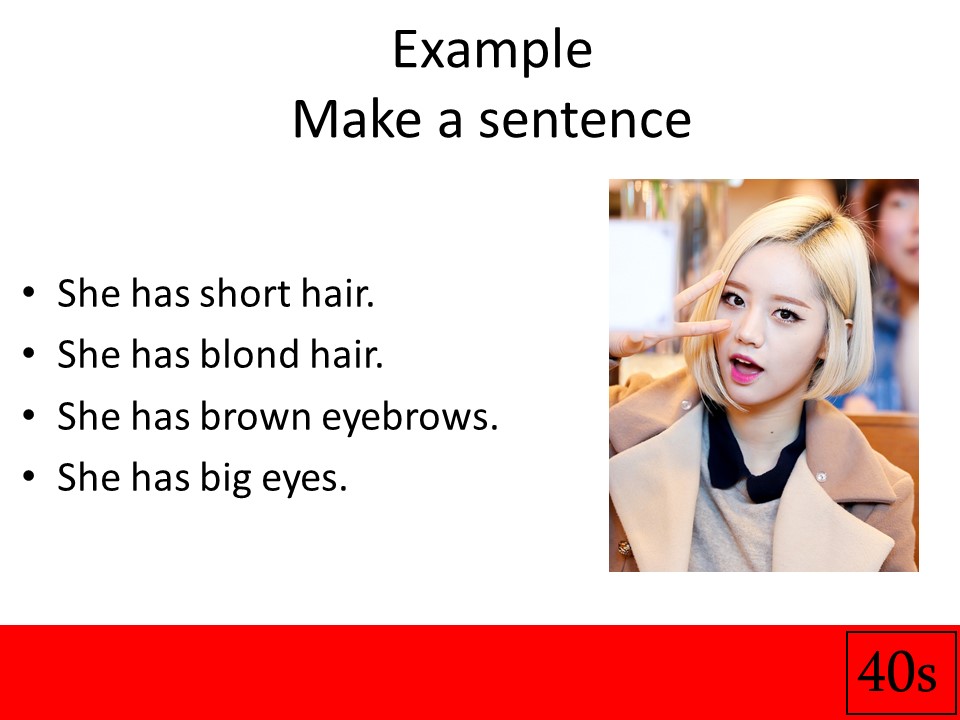
Expression - What does she look like? / She has long, curly and blond hair.
Listening, Speaking, Reading
Learning Objective:  Students will describe what the people look like.
Materials/Tools/Links
PPT file download, drawing papers, picture cards for drawing
Overview of Entire Lesson
Introduction         
Greeting (2min)
Review : Describing classmate (4min)
Introducing today’s lesson topic and activity (1min)

Development
Activity 1 (Practice describing people) (10min)
Activity 2 (Describing and drawing in pairs) (15min)

Consolidation
Wrapping up today’s lesson (3min)
Previewing the next lesson (2min)
Procedure of Portion Demonstrated
Introduction         
Greeting (2min)
Review : Describing classmate (4min)
-Guess who someone is.
-Someone has short hair and black eyes. Someone wear a dress. Who is she?
Introducing today’s lesson topic and activity (1min)
-Can you guess what we are going to learn?
-We will describe what the people look like

Development
Activity 1 (Practice describing people) (10min)
Activity 2 (Describing and drawing in pairs) (15min)

-One student draw what listened.
-The other students describes what the person looks like.