Showing posts with label Photos. Show all posts

Wednesday, August 12, 2020

Feelings and Emotions

 Topic :  Feelings and emotions😀

-Textbook/Chapter : 천재(함) Lesson 3. I’m happy. ( Grade Level:  Gr.4 )

-Learning Objective

  1. Students will be able to develop understanding about various vocabulary to express their own feelings and emotions.

2. Students will be able to ask and answer each other about their feelings and emotions using

the target language.


-Materials/Tools

: Emotions Chart, Wordwall, 

Worksheet with artistic pictures ( + differentiated worksheet for lower level students), Emaze


1. Reviewing last learning : Anagram(WordWall)+Whisper game (Group work)


2. Feelings & Emotions Modified Tic-Tac-Toe (Pair work- Pattern drills)


<Round.1>
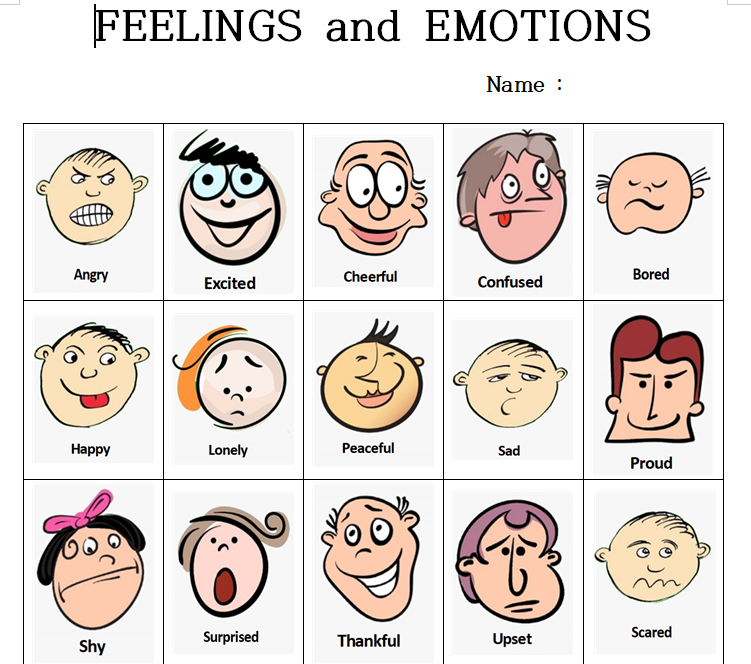
<Round.1>

  1. All cards are placed face down in a pile.

  2. First, choose a player to go first.

  3. You turn a card over and then your partner asks you “How are you feeling?”

  4. You have to answer along to the emotion on the card you turned over.

  5. You put your marks on the emotion.


<Round. 2>

  1. This time we’ll play the original Tic-Tac-Toe.

  2. The partner asks you “How are you feeling?” and the person who goes first answers any emotion she/he chose.

  3. Each player takes turns to block the other while trying to get the all-important three in a row!                                                                                                               

3. Write as many as you feel (Group work)

: This activity is planned as a differentiated lesson for lower level students.


*How to do

-Divide students into 2 groups of four.

-Sitting around in a circle having a picture for each. 

-Writing down words and emotions that come to the mind after seeing a picture in 20 seconds.

-Hand over the pictures to the next student and do the same activity.

-After each turn, students have a worksheet including a picture and write their short sentence starting with “I feel…..”
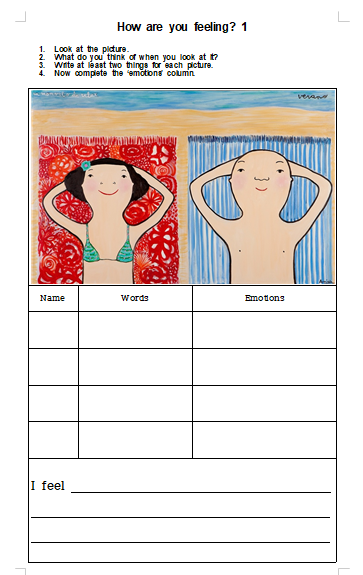
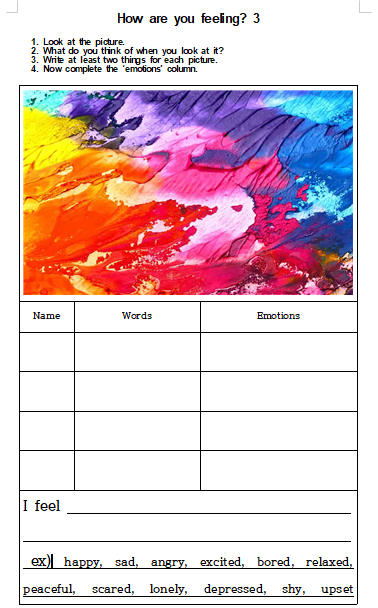
-Students can write about various emotions they and their mates felt.
-In each group, students who have the same picture gather (Group of Experts), and present their feelings and emotions about the picture.
-Students of the 'picture group' put the picture on the wall.
*differentiated worksheet for lower level students
4. Homework (Liveworksheet)

Wednesday, June 21, 2017

Running Drawing Dictation

look for two kids
1. Allocated roles(runner, writer, draw, helper)
2. Do the activity (The paper is on the table. A teacher only show a sentence and then the other sentences are hided.)
 3. Take a picture and then upload group worksheets at padlet app

Tuesday, May 30, 2017

Describe a photo with the given words and Draw a picture

1. Each pair is given a photo and some new words.
2. Ss write sentences to describe a photo.
    * SS have to use as many new words as possible and make sentences with them.
3. Ss read aloud the sentences to the other pair.

4. The other pair has to draw a picture.


<Useful Expression>

Monday, April 24, 2017

Spot the Differences with Photos

Find the Photo  Differences
Have students work in pairs. Give each pair two pictures that look similar, but include several differences. Students do not show the photos to each other.  They have to describe the picture and find both similarities and differences.  After this activity, tell the students to put the pictures side by side so that they can check whether the differences they found really exist or not. Sample Worksheet (answers) numbers & colors
If this is too difficult for students, you can give the two pictures to both students and have them work together to find the differences. To add interest for higher level students, use more realistic photos and have them them work together to write descriptions of the differences Specific language forms can be targeted.

Sources of ‘Spot the Difference’ Photos & Tasks:

Picture Dictations

Picture Dictations
Find a large magazine photo or textbook illustration that shows a specific setting (a city, park, kitchen, school, office, hospital, store etc) and several people engaged in a variety of activities. Don’t show learners the picture. Pre-teach any unfamiliar vocabulary you will use to describe the picture. Orally describe the picture, using level-appropriate sentences, and pausing between lines to allow learners to draw the picture while you describe it. Include some negative statements such as “The woman isn’t wearing a hat.” and confirm that learners don’t draw in response. Describe the picture a second time to allow learners to check their work. When finished, learners compare their pictures to the original and to each other’s pictures.  For higher level learners, pictures can be given to them and they can describe them to their partners. They can also choose from their own photos.

Picture Sources